Hold up your hand. Look at your fingers. Now ask yourself where “you” end and “not-you” begins.
The obvious answer is: at your skin. Your body ends where the air begins. Fine. But dig one layer down. The cells at the surface of your skin die and flake off every day, becoming dust on the floor. Were those cells you this morning? Are they you now, lying on the carpet? Somewhere between “living skin cell” and “particle of household dust,” the boundary of self was crossed. When?
Go deeper. Your brain contains eighty-six billion neurons. If a surgeon removed a single one, would you still be you? Yes. Two? A thousand? Ten million? Probably yes. A hundred million? Now we’re not so sure. Continue the removal and, at some point, you disappear — though no one can point to the specific neuron whose removal did it. Or run the experiment the other way: change the balance of serotonin, dopamine, and cortisol in your blood, and your mood shifts. Change it further and your personality shifts. Change it enough and the person your family knows is gone. Are you those neurotransmitters? If so, then the version of you reading this paragraph is a different self from the one who woke up this morning. If not — then what, exactly, do you mean by “you”?
The reductive answer our culture has settled on says: You are your brain. You are your chemistry. You are the biological machine having the experiences. And there is real truth in that. No one exists independently of their body — the body is not a mistake, and it is not a cage. But if the whole answer is just “you are your brain,” something in you should notice a problem. Because the protest itself is doing something a machine cannot: it is judging whether the answer is true. Whatever is doing the judging cannot be identical to what is being judged.
Or push the reduction further. From a purely physical standpoint, you are atoms and waves — the same atoms and waves that make up the table and the chair you are sitting on. At the atomic level, are you meaningfully different from the chair? Both are patterns of atoms held together by electromagnetic forces. Both obey the same physics. Look through the atomic lens and the distinction between you and chair begins to blur. And yet, the moment you look up from the microscope, you know: I am not a chair. The atomic lens, however true, is not showing the whole story. Physics is real. Biology is real. Chemistry and neurons are real. Each lens reveals something genuinely there. Through different lenses, different realities are revealed — and no single lens sees the whole of what you are.
Three Patterns, One Life
Notice what happened in the last paragraph. When we tried to find “you” by cutting the body into smaller and smaller pieces, we lost you. The answer to the puzzle of the self is not going to be found by reducing. The reductive move — “you are just chemistry” — makes the self disappear the moment it succeeds. This is what science and modern culture have been attempting to do.
What if the answer is not smaller, but layered?
Look at yourself again, this time in a different way. Three distinct patterns are operating right now in the room where you are sitting. All three are happening in the same body. None of them is you, and yet all three are inseparable from you.
The first is the pattern of physics. The very fact that atoms hold together, that electrons stay in their orbits, that gravity keeps you in your chair — these are not accidents. They are the fundamental structure of this universe: a specific, precisely tuned pattern that makes matter matter. If a handful of these physical constants were slightly different, atoms would not form, stars would not ignite, chemistry would be impossible, and no life of any kind would exist anywhere. This universe has an underlying pattern — an underlying grammar — and the physicists have been describing it for four hundred years without exhausting it.
The second is the pattern of biology. Out of physics, chemistry emerges. Out of chemistry, life emerges. But life is not just complicated chemistry. Living systems do something dead matter cannot: they seek. A cell divides. A plant turns toward light. Your heart beats without your consent, coordinating a thousand chemical events per second to keep the whole system alive. Biology is a pattern of purposive activity — one that obeys physics without being reducible to it. You could describe every chemical reaction in a living cell and still not have described what makes it alive.
The third is the pattern of the self. Out of biology, consciousness emerges. Out of consciousness, the interior life emerges — thinking, willing, loving, remembering. And again: this is not just complicated biology. You are not merely a very elaborate cell. Your inner life knows itself. It looks back at itself. It decides, and sometimes it decides against its own biology — the person who fasts, the mother who runs into a burning building for her child, the soldier who dies for a friend. Biology says preserve yourself. The self can override that. Something is going on here that biology alone cannot account for.
Three distinct patterns. Physics beneath biology beneath the self. Not pieces of you — not “part of you is physics, part is biology, part is the self.” All three are the whole of you, at three different depths.
And here is the thing worth noticing: all three obey the same underlying grammar.
They are three visible expressions of one hidden logic — call it, for now, the way things hold together. Break the physics and the biology dies. Damage the biology and the self dissolves. Wound the self and the biology follows it into the ground; people who lose the will to live often die of nothing in particular, and doctors have known this forever. The three patterns are one life, expressed at three levels.
And yet all three have their own distinct rules and their own personalities. Every action has an equal and opposite reaction. A shock to the heart will jolt the whole body. Boredom and lack of love can kill.
We are used to thinking of ourselves as made of parts. Atoms building molecules building cells building organs building a body inhabited by a person. That is the reductionist story, and it is not wrong — every one of those levels is real. But it is only half the story. The other half is the part the reductionist cannot see: the same one pattern is present at every level, all the way down and all the way up. The self is not built out of the biology; the self is what the biology has been aiming at all along. The biology is not built out of the physics; the biology is what the physics has been aiming at all along.
Now — before we make the next move — a warning.
It is going to be tempting, in a paragraph or two, to say that this pattern points to God. And it does. But not in the way most modern people will first hear it. Because most modern people, when they hear the word God, are still hearing an idea that Christianity has been trying to correct for two thousand years. Before the analogy can point at anything true, we have to clear that idea out of the way.
The God Our Culture Inherited
When you read the word God just now, what came up?
For most people in the modern West, the answer is some version of the same picture: a very powerful being, somewhere out there, in charge of things. Old man on a cloud. Cosmic force. Prime Mover. The Big Guy in the Sky. The details vary; the structure does not. It is a being — bigger and older and more powerful than we are, but a being nonetheless. Something you could, in principle, meet.
This is roughly the God of the Odyssey.
Not literally — no serious modern person believes Zeus is real. But the structure of the picture is Greek. In Homer, the gods are super-humans. They have personalities. They eat, argue, fall in love, and go to bed angry. They are more powerful than we are, and they live in a nicer neighborhood, but they are the same kind of thing we are. They are beings among beings, differing from us in degree.
That picture — a supremely powerful being, still on the same shelf with everything else — is what most modern people mean by God. And it is precisely this picture that has to be surrendered before the God of the Bible comes into view.
Because the God of the Bible is not a being among beings. When Moses asks for God’s name, the answer he gets back is not Zeus or Marduk or any name that would fit on a shelf. The answer is: “I AM WHO I AM” (Exodus 3:14). Not “I am the powerful one.” Not “I am the ancient one.” Just: I am. God does not have Being. God is Being. God is not on the shelf; God is the shelf. Everything that exists exists within God, participates in God, is held in being by God. There is nothing “outside” God for God to be next to. God simply IS.
This is why, in the Christian tradition, God has been described as simple — not in the sense of “easy to understand” (God is anything but easy to understand), but in the sense of not-composed. God is not a fact about the universe. God is the reason there is a universe rather than nothing.
God is LOVE
And now — the sentence the whole Christian revelation turns on — we can say what God is.
“God is love.” (1 John 4:8)
Read that slowly. It does not say “God loves.” It does not say “God is loving.” It says: God is love. Love is not something God does or feels or has — love is what God is. If you took love away from God, you would not have God-minus-love; you would have nothing. The Being that gives being to everything is identical to the act of self-giving.
Which means: whatever else God is, God is inherently relational.
Love is not a thing. Love is not a feeling. Love is what happens between — between a lover and a beloved, between two who give and receive in the same movement. A person can be angry alone; a person cannot love alone. Love, wherever it appears, requires at least two. If God is Love — really, essentially, all the way down — then God is not solitary, not a single divine Individual sitting by Himself before creation. God is, from all eternity, relationship.
The pagan picture cannot hold this. Zeus is powerful, but Zeus is one. He has relationships — with his wife, his brothers, his mortal children — but those relationships are with others, beings outside himself. Take away every other being and Zeus is still Zeus, alone on Olympus. That is a being. That is not Love.
The Christian God is different in kind. Not because Christianity claims “our god is bigger than yours” — the claim is more radical than that. The claim is that the ultimate reality is not a thing, however great. The ultimate reality is the act of loving itself. And that act, in order to be an act, requires a giver, a receiver, and the giving-that-passes-between them.
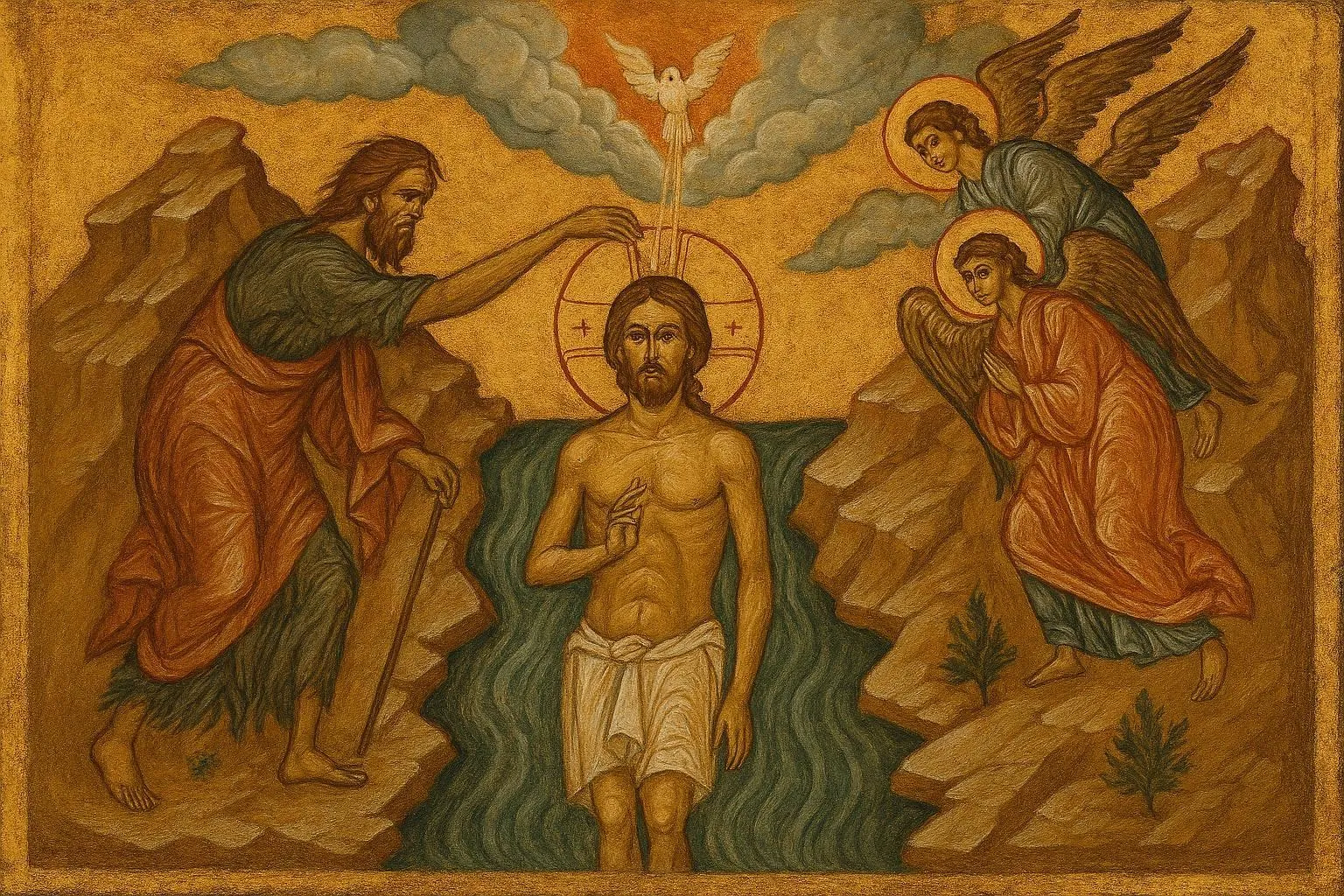
Which is exactly what the Christian tradition means when it says: God is Father, Son, and Holy Spirit.
The Three-in-One and the Mystery it Reveals
Christian tradition, working from the Scriptures and from four centuries of prayer and controversy, arrived at a formulation for what it saw. It said: one nature, three Persons.
Nature — one. The Father, the Son, and the Holy Spirit share the whole of what God is. Not divided among them, not distributed in thirds. All of God is in each of them, and each of them is fully God.
Persons — three. The Father is not the Son is not the Spirit. They are irreducibly distinct — not three modes or masks of one being, but three genuinely other Ones who eternally know and love each other. Similar to how the multiple layers of our physics-biology-self metaphor all are inseparable from the body, yet still distinct in their proper character and mode of being.
The tradition summarizes both halves in a phrase echoed since the Council of Chalcedon: united without confusion, distinguished without separation. Collapse the distinction and you get one solitary God in three costumes — the ancient heresy of modalism. Break the unity and you get three gods, each smaller than the whole — the ancient heresy of tritheism. Christian faith walks the ridge between.
And here is where the honest teacher of the faith has to say: we do not understand this. Not fully.
The Trinity is not a puzzle to be solved and fully comprehended. The Trinity is a revealed mystery — real, disclosed, worshipped for two thousand years — but not one that fits inside our concepts without remainder. St. Paul wrote of this directly:
“For now we see in a mirror dimly, but then face to face. Now I know in part; then I shall understand fully, even as I have been fully understood.” (1 Corinthians 13:12)
The Trinity is chief among the things we know now in part.
And this is where the deepest thing must be said aloud: the Trinity is a mystery. Not a puzzle we haven’t yet solved. A revealed mystery — given to us in enough measure to worship and to be transformed by, but not in a measure we can reduce to a diagram. The interior how of God’s own life is beyond us on purpose.
Many people struggle with the Trinity because they try to apply a scientific, empirical mindset to it — as if God could be measured and fully described. But we live in a world that is still, in its fullness, separated from God. God is with us now, yes; but the fullness of God will not be revealed until the new heaven and new earth.
Many have attempted to name this mystery. The most enduring analogies have shared one shape: not three parts, but a communion. St. Augustine offered the human mind — memory, understanding, and will — three powers of one soul, each existing only in relation to the others, none surviving alone. St. Maximus the Confessor, writing in the seventh century, went further: every created thing has a logos, an eternal principle held in the one Logos through whom all things were made (John 1:3). Creation is not built out of pieces. Creation is shot through with relationship.
This is the direction the physics-biology-self image metaphor has been pointing all along.
Not as a fixed anthropological catalogue. Not as a demonstration that “things come in threes.” Consider carefully what the analogy actually gestures at.
Physics does not create biology — and yet biology proceeds from the rules and character of the physics of this universe. There was not a moment when physics existed on its own and then produced biology later, the way a grandfather produces a father who then produces a son. That would be the pagan picture returning through the back door — the divine as a genealogy, a chain of separate beings arranged in sequence. The Trinity is not that. In the image we’ve been circling: physics and biology and the self do not stand in a before-and-after relation. They stand in a within-and-through relation. Where you have physics, biology becomes possible; where you have biology, the self becomes possible; and yet none of the three exists on its own. The three are eternally distinct — really, genuinely, irreducibly distinct — and they are inseparably one life. That is what the analogy is meant to gesture at. Not a chain. A communion.
In Part
We began with a hand held up to the light and the simple question of where you end. We have come to the edge of the deepest mystery there is — three Persons, one communion, the Love that gives being to everything — and to the honest admission the tradition has always made along with it: that we see this truly, but never wholly. In a mirror, dimly, Paul said — the phrase this article takes its name from. Not darkly. Dimly. A mirror dimly is still a mirror; what it shows is real, even when it is not the whole.
What we have seen is enough to worship. But it is not the end of the matter — because the Trinity is not only a communion to be studied from the outside. It is a communion we are invited into. That astonishing claim — the whole reason any of this was revealed — is where the companion to this piece begins: The Pattern Made Flesh, where the communion we have traced becomes flesh in Christ, and reaches out to draw us in.