This is the second of a two-part meditation. The first part began where a modern reader actually lives — in the puzzle of the human person, the self that dissolves the moment you try to reduce it to chemistry — and worked outward until it arrived at the heart of the Christian confession: that God is not a solitary being, and not a chain of powers arranged in sequence, but a communion of love. Father, Son, and Holy Spirit — united without confusion, distinguished without separation. Not a chain. A communion.
That could be where it rests: a beautiful doctrine, admired from a respectful distance. It does not rest there. Because the claim the whole Bible has been building toward is stranger, and far closer, than a doctrine to be admired. It is that we are not meant to stand outside that communion and study it. We are meant to be drawn in.
The Pattern Made Flesh, and Our Part in it
The New Testament writers reached for the closest images their world could offer in trying to explain our relationship to the Triune God. St. Paul turned again and again to the language of a body: Christ is the Head, and we are the members (Ephesians 1:22-23; 1 Corinthians 12:12-27). Elsewhere the image is a Bride: Christ is the Bridegroom, the Church is His Bride (Ephesians 5:31-32; Revelation 21:2). These were reaches — Paul working with the biology, the marriage-imagery, the political language his world understood, straining to name a reality that no first-century category could hold. And, like every analogy for God, none of them captured the whole. Paul knew this. The whole tradition has known it.
But what Paul was reaching for — and what the tradition since has confessed — is a claim more astonishing than any single image can hold: we are not standing outside the relation of the Trinity, looking on. We are invited into it.
Christ Himself says this most directly, in the great high-priestly prayer He offers the night before His death:
“That they may all be one; even as Thou, Father, art in Me, and I in Thee, that they also may be in Us… I in them and Thou in Me, that they may be perfectly one.” (John 17:21, 23)
Read that as slowly as we read “God is love” in the first companion article to this one. Christ is asking that the eternal relation between Himself and the Father — the very relation that is at the center of the Triune life — be extended to us. Not as a metaphor. Not as poetic flourish. As reality. That the same love which eternally passes between Father and Son might, one day, fill us so completely that we live in that relation as truly as the Persons Themselves do.
This is the invitation the whole Bible has been leading toward. And the moment that makes it possible is the moment God, without ceasing to be infinite, entered creation as one of us.
Theophany and Theosis
The Word became flesh. (John 1:14)
The Word became flesh; not a costume worn by God like in the Odyssey, not a divine spirit borrowing a body — the infinite Son of the eternal Father, without ceasing to be infinite, took up finitude. Real physics. Real biology. A real human self, bounded by time and by space, of a specific mother Mary, in a specific town Bethlehem. God, unbounded, chose bounds — chose the size of an infant body, the length of a human lifetime, the reach of two human arms. St. Paul calls this the emptying (Philippians 2:7): God does not stop being God to take on human limits; God takes on human limits within His infinite life, so that a human life could at last be lived as it was designed. In that one Person — Jesus of Nazareth — human nature was being lived, for the first time since Eden, exactly as it was made to be.
But this wasn’t the only reason God took on humanity in Christ. After all, Mary too — by the help of God’s grace — lived an immaculate life, fulfilling the original plan for humanity. What Christ’s incarnation was then was not just man living perfectly, but man and God living and acting in full communion. The most dramatic revelation of this comes at the beginning of His public ministry, at the river Jordan.
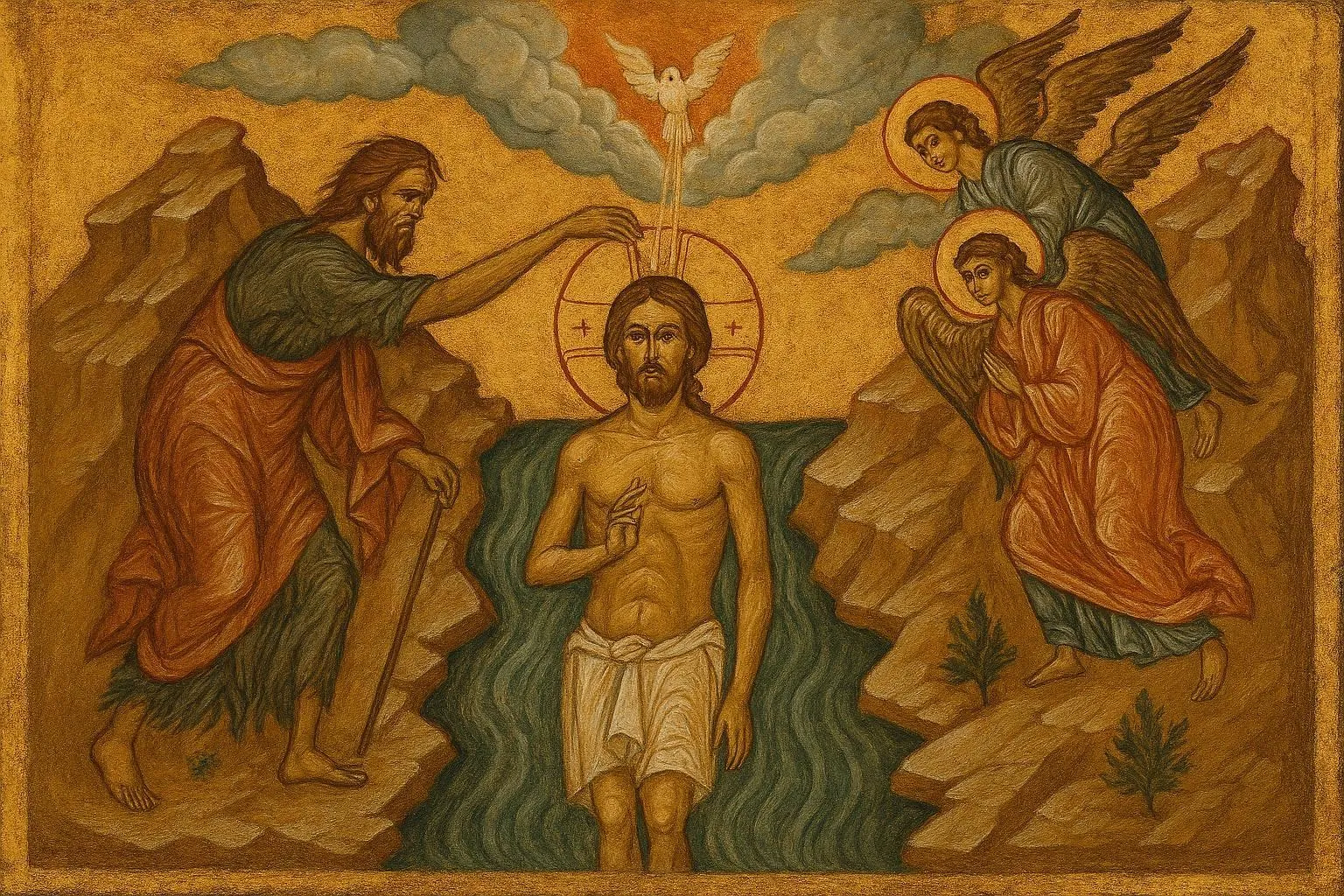
Jesus comes down to the waters of the River Jordan, down to the lowest land on Earth. He steps in — a real body, in real water, obeying the ordinary rules of physics. He is baptized by John. And then, the Gospels tell us, something happens that had never happened before:
“And when Jesus was baptized, immediately He went up from the water, and behold, the heavens were opened, and He saw the Spirit of God descending like a dove, and alighting on Him; and lo, a voice from heaven, saying, ‘This is My beloved Son, with whom I am well pleased.’” (Matthew 3:16-17)
The Eastern tradition calls this the Theophany — the manifestation of God. Not because God had never been active before; God had been at work through every prophet, every psalm, every act of creation. But because this is the first moment in history that the entire Trinity is simultaneously visible to human eyes and ears. The Son standing in the water. The Spirit descending. The Father’s voice from heaven.
Notice how it happens. The Trinity does not reveal itself abstractly — the sky does not split with a voice announcing “we are three.” The Trinity reveals itself through a human person whose whole nature is finally at rest in what it was made to be. Christ’s body, obedient. His inner life, undivided. His will, freely aligned with the Father in the Spirit. His whole created humanity offered to God in one perfect act. And in that moment the fullness of the Triune God shines through.
This is what we were made to be. And this is what the Incarnation, when Christ became man, was for: to show us the pattern of the union we are meant to take on.
The Fathers of the Church, especially in the East, gave this a name: theosis — deification, divinization, becoming by grace what Christ is by nature. Not becoming God. Never that; we are creatures, always. But becoming what a creature looks like when its layered structure is finally in tune with the Triune life it was made to reveal. Every relationship, down to the cellular level, working in harmony, free of corruption.
St. Athanasius put it in a line that has echoed through the Christian centuries: “God became man that man might become God.” By which he meant: Christ took up our nature and healed it from the inside, so that we, in Him, could be lifted into the life of the Trinity. Not as new members of the Godhead — the Trinity is closed to what it eternally is — but as adopted sons and daughters, drawn into the love that passes eternally between the Father and the Son in the Spirit.
Every Christian baptism, from that day to this one, is a participation in His baptism and the reorientation of your being towards God. When the priest lowers you into the water and calls the Spirit down and names you a child of the Father, the same three-fold action of Theophany happens over you — because you are being joined to the Son in whom it first happened. You come out of the water called newly illumined (the Byzantine baptismal rite’s actual name for the newly baptized). That is why we consider baptism not as an act requiring our own faith — as if faith alone were the healing action — but as an actual healing performed on us through the Divine Grace of God. The pattern in you begins to sing back into tune.
Not Solved, but Entered
Christian faith does not ask you to solve the Trinity. It never has. The Trinity is not a doctrine to be mastered before you can belong to it; it is the eternal reality within which you are already living, moving, and being — whether you knew it or not, whether you could ever articulate it or not. Every prayer prayed in Christ’s name is offered within the relation of the Son to the Father, in the Spirit. Every reception of the Eucharist is a participation in the self-giving that eternally passes among the Persons. Every act of love, however small, is a footprint of the same Love the Triune God simply is — because there is no other kind of love in the universe than that one.
So the invitation was never, in the end, to understand. It is to enter. To be joined to the Son in the water and drawn, in Him, into the life He shares with the Father and the Spirit. To let the pattern that runs out of tune in all of us — cell and will and love — be tuned again, slowly, over a lifetime, back toward the harmony it was made for. That is the whole point of the Incarnation, and the whole point of the Christian life: not information about God, not simply living a sinless life, but participation in God.
And what we are given now in part, we will one day be given in full. What the Fathers only glimpsed, what the saints have spent their lives slowly becoming, what begins in every baptism and deepens in every Eucharist — all of it waits to be completed at the end of time, when the then Saint Paul longed for finally comes: no longer in part, but face to face (1 Corinthians 13:12). Not concept, but vision. Not doctrine, but the very life we were made for. The pattern in you, at last, singing perfectly in tune. The relationship you were made to be drawn into, made complete.
The mystery, not solved, but entered.